
Understanding Conventional Dry Offset Printing
Dry offset printing is a well-established process for decorating plastic packaging, particularly tubes, cups and other cylindrical containers.
The process uses printing plates to transfer individual ink colours onto a common blanket, which then transfers the complete design onto the packaging surface in a single printing operation.
One of its main advantages is its ability to combine multiple spot colours with excellent registration at high production speeds.
Dry offset printing is particularly suitable for packaging designs featuring solid colours, logos, text and relatively simple graphic elements. Its reliability and productivity make it a preferred solution for manufacturers producing large quantities of standardized packaging.
However, conventional dry offset printing has certain limitations when reproducing complex photographic images, smooth gradients and fine details.
What Is Prime Offset Printing?
Prime Offset is an advanced offset printing technology developed to overcome some of the traditional limitations of conventional dry offset printing.
By combining optimized printing processes, waterless printing plates and dedicated inking configurations, Prime Offset enables manufacturers to reproduce high-definition graphics with significantly greater precision.
Prime Offset combine CMYK printing with additional spot colours, making it possible to maintain precise brand colours while achieving photorealistic visual effects.
This creates new opportunities for manufacturers looking to offer premium packaging decoration without moving away from an established offset production environment.
What Are the Main Differences?
Print quality and design possibilities
Conventional dry offset excels at reproducing solid colours, logos and text with excellent consistency. Prime Offset expands these capabilities by enabling more sophisticated CMYK reproduction, including photographic images, smooth gradients and fine details.
Colour management
Dry offset printing traditionally relies on spot colours to achieve precise colour reproduction. Prime Offset can combine process colours with additional spot colours, providing greater flexibility for complex packaging designs.
Production efficiency
Both technologies are designed for industrial production and can achieve high productivity. Prime Offset offers additional design possibilities while retaining many of the operational advantages associated with offset printing.
Flexibility
Conventional dry offset is particularly efficient for established designs using spot colours. Prime Offset becomes especially attractive when manufacturers need to reproduce more complex graphics or expand their decoration offering.
Can Both Technologies Be Combined?
One important development is the possibility of combining conventional dry offset and Prime Offset capabilities within the same production equipment.
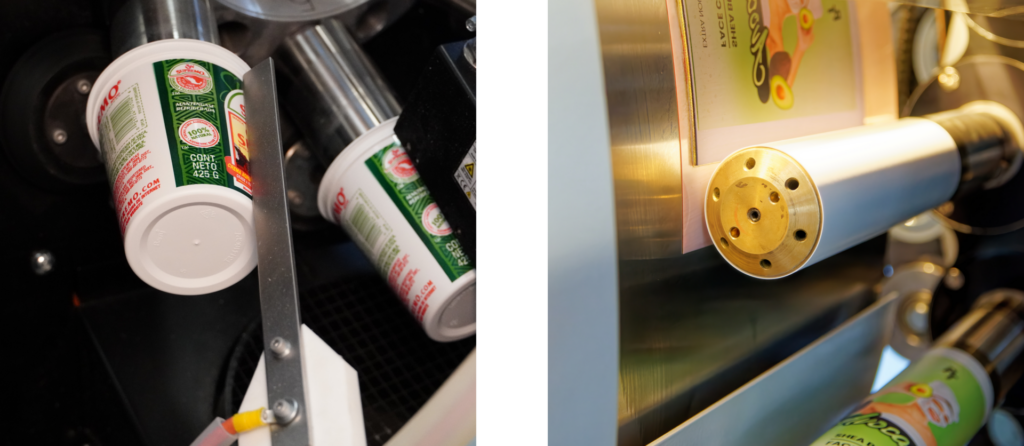
Polytype’s Hybrid Prime configuration is primarily designed for conventional dry offset production while also allowing manufacturers to reproduce photorealistic designs using CMYK inks and waterless printing plates.
This approach provides additional flexibility for manufacturers whose production remains largely based on conventional designs but who want to respond to growing demand for more sophisticated packaging decoration.
Rather than replacing conventional offset printing entirely, hybrid configurations allow manufacturers to expand their capabilities while maintaining compatibility with existing production requirements.
Choosing the Right Technology
The choice between Prime Offset and conventional dry offset depends primarily on the complexity of the packaging design, production requirements and the manufacturer’s long-term objectives.
For applications dominated by solid colours, logos and standardized designs, conventional dry offset remains a highly efficient solution.
For manufacturers seeking to reproduce photographic images, complex gradients and premium visual effects, Prime Offset offers additional possibilities.
Ultimately, these technologies should not necessarily be considered competitors. Instead, they represent complementary approaches to offset printing, allowing manufacturers to select the most suitable process for their specific applications.